
A couple of weeks ago, Mark and I went to London for two purposes – firstly, to see our new home, and secondly, to hear Jacinda Ardern, the former Prime Minister of New Zealand, speak at Central Methodist Hall on Leadership and Empathy.
From the moment Jacinda Ardern was elected as Prime Minister in 2017, I was incredibly taken with her. She seemed like a breath of fresh air in a world of often hard-edged politics. She was about the same age as me – something I found both humbling and inspiring – and she was doing something only one other world leader had done before: have a baby whilst in office.
But more than that, she felt entirely human. After the terror attacks on a mosque in Christchurch, she didn’t arrive with fanfare or force, she arrived with tears. She wept with the people. She spoke from the heart. And she made decisions that weren’t always popular, but at their centre they protected and safeguarded some of the most vulnerable in society. She shone with empathy.
As someone who wears her own heart very openly, who is often led first by compassion, I was drawn to that – that you could lead, and still be that way. You didn’t have to put on armour to lead. You didn’t have to harden your heart to hold authority.
Jacinda spoke of imposter syndrome – of those moments where you feel you shouldn’t be leading at all. She spoke honestly about her fears, not just as a woman or as a mother, but as someone charged with leading a complex nation. Her vulnerability was not a weakness; it opened doors. It allowed her to enter rooms others couldn’t, because they had too many walls around them.
She spoke of her own failures, her missteps – and also the moments of grace, the ones she quietly considered successes. I left Central Hall inspired. In just a few months, I will be entering a new phase of ministry and leadership. And I left that day not only inspired by her, but strangely affirmed – that the qualities I sometimes think disqualify me from leadership might actually be the gifts God has given for that very calling. In fact she said empathetic leadership can look like “labrador leadership” that entirely appeals to me as one who bounds around wagging her tail a lot.
And yet, as we made our way back to Cardiff, something else struck me more deeply – something so many of my cohort at theological college also wrestled with. God often calls us – not when we feel ready, not when we feel equipped, not when we’ve got everything lined up neatly – but when we least expect it, and often when we feel most unworthy.
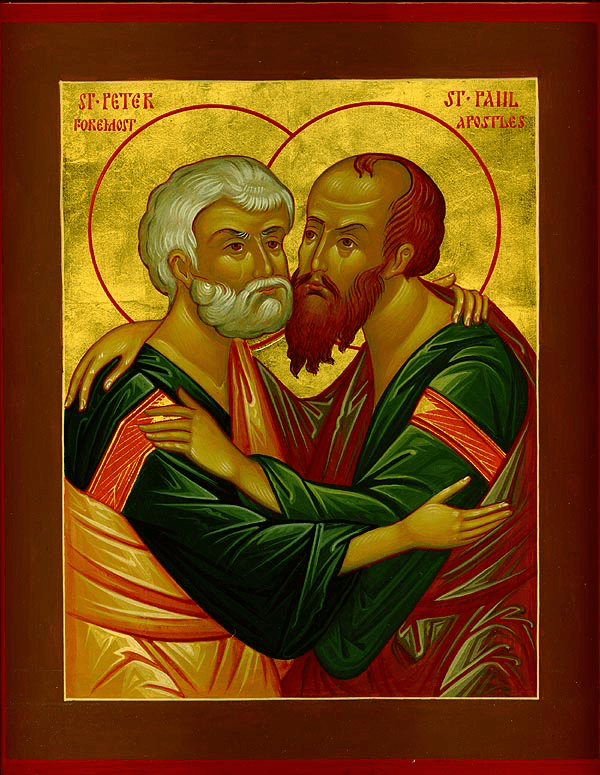
Jesus’ disciples are probably the finest example of that. A motley crew by any earthly standards. And yet Jesus saw their immense worth – but it almost always began with their vulnerability. And today, as we remember St. Peter and St. Paul, we are reminded just how true that is.
Peter – The Rock with Cracks
Peter, the fisherman from Galilee. Loud, impulsive, deeply loyal, but often confused. Peter who is so full of love one moment and then full of fear the next. Peter who proclaims Jesus as the Messiah, but then moments later can’t stomach the idea of Jesus’ suffering. Peter who swears he will never abandon Jesus, and yet denies him three times before the cock crows.
And yet this is the one Jesus calls the rock on which he will build his Church. Not because Peter is faultless – quite the opposite. He is a walking paradox: bold and cowardly, faithful and unsure, confident and confused. But he is also willing. Willing to follow, to repent, to try again. Willing to grow.
What’s more, Peter is someone we can all recognise. He’s so human. And maybe that’s why Jesus chose him. Because his calling would always be rooted in realness. He would never be too perfect to be relatable. He would never be so polished that others couldn’t come close. And when he got it wrong – which he did, plenty of times – he allowed those moments to reshape him.
The fact that Peter goes from “Simon son of John” to “Simon Peter” and then simply “Peter” speaks to a journey of becoming. And Jesus used those names to call him forward. Sometimes gently, sometimes with challenge. It wasn’t a case of Peter becoming someone else – it was Peter becoming more fully himself, the self God had seen from the beginning.
Paul – The Passionate Convert
And then there’s Paul. If Peter is the one we warm to, Paul is sometimes the one we wrestle with. He’s fiery. He’s certain. He doesn’t always come across as easy company. And yet God calls him, too.
At the time of his conversion, he was not just outside the Christian faith – he was persecuting it. Actively working to suppress and destroy it. He was feared by the early followers of Jesus. And yet God saw something in him. Not just potential, but a heart that, once turned, would be utterly relentless in love.
Paul’s transformation wasn’t a simple pivot, it was a complete upheaval. From one who harmed the church to one who gave his whole life to build it. From one who jailed Christians to one who was jailed for the faith himself.
And even in his certainty, even in the things he writes that may make us wince, Paul never speaks from comfort. His letters were often written from places of suffering. His leadership and calling wasn’t marked by ease, but by endurance. And again, by vulnerability. We don’t get a perfect man, we get one who was willing to let God completely change the direction of his life.
Leadership as Calling, Not Qualification
And so, here we have these two saints – Peter and Paul. One impetuous, earthy, full of heart. The other sharp-minded, determined, a little difficult. Both unlikely. Both flawed. Both called.
And that tells us something. That leadership and calling in God’s kingdom isn’t about having the right CV. It isn’t about ticking all the boxes or being universally admired. It’s about being willing. Willing to be reshaped. Willing to speak the truth. Willing to own our mistakes. Willing to lead not from a pedestal, but from a place of shared humanity.
Being called by God begins in vulnerability and becomes something powerful – because it doesn’t demand perfection. It invites transformation. And it allows God to do what only God can do in us.
Conclusion: What Might God Be Calling You To?
So perhaps the real question today is: what might God be calling you to?
It might not be something public or grand. It might not come with a title or a collar. It might be the quiet calling of love within your family. The calling of speaking truth in a place that needs it. The calling of forgiveness in a relationship long strained. Or the calling of simply saying, “Yes Lord, I’m willing – even if I’m scared.”
God does not wait until we’re ready. God calls us when we’re real. And then God walks with us – just as he did with Peter, and with Paul – as we become who we were always meant to be.
Yesterday I was at the ordinations at Newport Cathedral as a dear friend of mine was ordained Priest, always a profound moment, and I was moved by one of the final prayers over all the variety of ministries in our churches today, and so to end I wish to pray that prayer for us, as we open our hearts, minds and lives to the calling that Christ has on all of our lives:
Let us pray:
Almighty God, who for the salvation of the world
Gives to his people many gifts and ministries
To the advancement of his glory,
Stir up in us the gifts of his grace
And sustain each one of us in our own ministry,
Through Jesus Christ our Lord.
Amen.
 Ruth Greenaway-Robbins
Leave a comment