
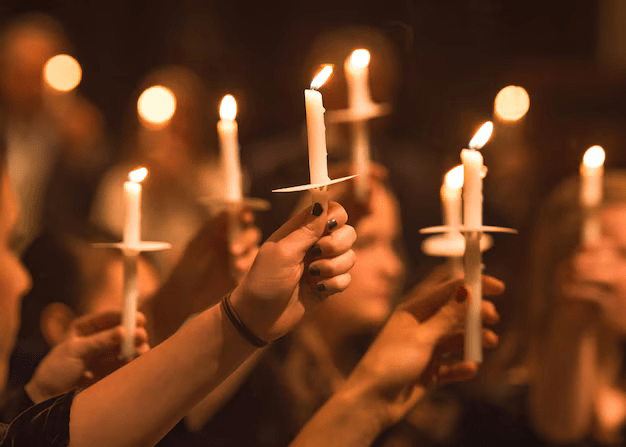
This week we celebrate the Feast of All Saints, and as I prepare our all-age sermon slot, I found myself thinking about mirrors.
Not the kind that help us fix our hair (though there’s always that!), but the mirrors that help us look deeper – beyond the surface – to see something sacred reflected back.
When we look in a mirror, we see what’s on the outside. But I wonder with you: if we stay there a little longer, perhaps we can begin to glimpse something else – a face made in the image and likeness of God.
That’s the astonishing truth of imago Dei: that each one of us, without exception, bears the reflection of the divine. And yet, so often, we find that hard to believe about ourselves. We may say it easily about others, but we struggle to extend the same grace inward.
A mirror to the saints
On All Saints’ Day, we remember the great saints – Saint Peter, Saint Paul, Saint Mary, Saint Francis, and Saint Andrew, the patron of the place where I serve as priest. But it also affords us the opportunity to remember and give thanks for the quiet, everyday saints whose names are known only to a few – the ones whose work in our lives has held us up, whose prayers have carried us, whose love has made God visible.
They are saints not because they were perfect, but because they reflected God’s love into the world.
And here’s the thing: we are called to do the same. When we look in the mirror, we are looking at a saint in the making – an imperfect, beloved person through whom God’s light can shine.
I often ask myself: who has helped me see what God’s love looks like? And, in turn, how might I help someone else see that same love in me? These are important questions to keep asking ourselves.
Self-compassion and the image of God
I also want to consider another lens to understand our sainthood and that is through the lens of self-compassion, which I believe can be a thread that holds all of this together.
Over the last five or six years, I have become deeply interested and inspired by the work of Dr Kristin Neff on self-compassion. Her writing, research, and guided practices opened a new space for me: a way of noticing the tone of my own inner voice, of holding my failures and fears with gentleness rather than judgement. As I’ve explored and prayed through this, self-compassion has gradually become part of my spiritual life – a kind of contemplative practice that helps me return again and again to God’s mercy and God’s love. It has shaped how I pray, how I rest, and how I accompany others – reminding me that grace begins not with striving, but with acceptance.
It is important to note self-compassion isn’t self-indulgence or an excuse to stop growing. It is the practice of acknowledging our humanity – our limits, our mistakes, our need for grace – and yet choosing to treat ourselves with the same kindness we would offer a good friend.
When we practise self-compassion, we begin to live more deeply into the imago Dei. We honour the God who made us and see ourselves as God sees us – not as problems to be fixed, but as beloved creations still unfolding.
There’s a quiet holiness in that.
Because when we stop waging war on ourselves, we become freer to love others. When we stop demanding perfection, we start making space for joy. And when we look at our reflection with gentleness instead of judgement, we begin to reflect that same gentleness into the world.
Kingdom People: compassion turned outward
The lectionary this week invites us to reflect on Saint Luke’s Gospel, where Jesus gives us the Beatitudes – a vision of the Kingdom of God that turns everything upside down.
It isn’t the powerful or the wealthy who are blessed, but the poor, the hungry, the grieving, the merciful, and the peacemakers.
To live as Kingdom People means to embody that compassion – not just outwardly, but inwardly too. Because how we treat ourselves shapes how we treat others.
If we learn to see ourselves through God’s compassionate gaze, we’ll find it easier to see others that way, too. We’ll make different choices – lighter, kinder, more hopeful ones.
A simple practice
So, here’s a gentle invitation for the week ahead.
Self-compassion is a practice – that is, we have to practise it to make it part of our being. So I invite us to practise knowing ourselves as made in the likeness and image of God.
Find a mirror or a reflective surface – a window, a puddle, the gleam of a kettle.
Look for a moment at your reflection and whisper this prayer:
“I am made in the image of God.
I am loved.
I am called to love.”
Let those words settle in your heart.
Notice what it feels like to believe them.
And then carry that truth into the way you speak, act, and move through the world.
Holiness, not perfection
All Saints reminds us that holiness is not about perfection – it’s about reflection.
It’s about letting God’s light be seen in us, just as we glimpse it in others.
When we see ourselves as made in the image and likeness of God, we clear the glass of the mirror of our lives, make space for grace, and begin – in small and beautiful ways – to live into the image of God we already bear.
My prayer for us this week is this: may we see ourselves as God sees us – beloved, capable of healing, radiant with divine light.
And may that gentle seeing lead us to live more fully, more freely, and more compassionately in God’s world.
Amen.
 Ruth Greenaway-Robbins
Leave a comment