
A Sermon for Second Sunday in Advent
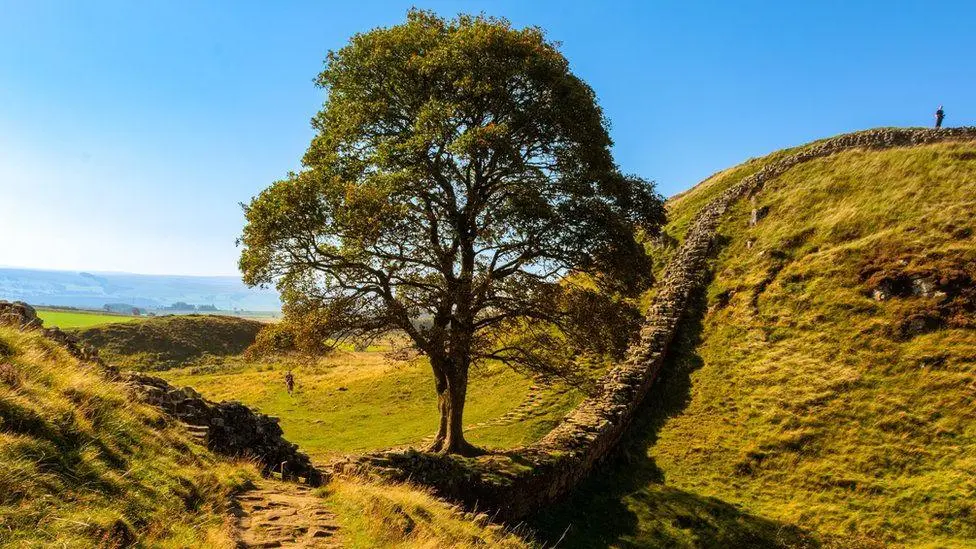
If you’ve ever walked the Hadrian’s Wall path in Northumberland, you’ll know the Sycamore Gap tree – an iconic, solitary sycamore tree standing in a dramatic dip in the landscape. For decades it was one of the most photographed trees in Britain. Strong, rooted, quietly majestic. Bizarrely, my first memory of it was from watching Robin Hood: Prince of Thieves a classic of 1991, now I’m showing my age.
And then last year it was felled.
Deliberately.
You probably heard about it on the news.
A senseless act of vandalism that left people across the country shocked and grieving. A beautiful, living thing reduced to a stump.
I think the reaction was so strong because the tree represented more than itself. It stood for endurance, beauty, rootedness – the idea that amid all that changes of this world, something can remain steady. Its felling felt like a small symbol of the fragility we all feel in the world right now.
But the story didn’t end there.
Forestry experts discovered something remarkable.
The tree is trying to grow again.
In fact according to the National Trist there are 25 new shoots are emerging from the stump – small, tender signs of stubborn life. And more: hundreds of cuttings were taken from the fallen tree, many of which have rooted successfully. These new saplings are being nurtured across the UK to be planted in the years to come.
What looked like an ending has become the beginning of a much wider legacy.
When I heard that, I thought: this is exactly what Isaiah is talking about.
This is Advent.
“A shoot shall come out of the stump of Jesse.”
Isaiah speaks into a landscape of despair.
The royal line of David, Jesse’s family, had been cut down by war, exile, and failure. The tree of Israel’s hope had been reduced to a stump.
And yet Isaiah dares to say:
“From here, from what looks dead, God will begin again.”
God’s peace grows not in ideal circumstances but in places that look ruined: Where life has felt cut down, Where hope seems thin, Where the world feels violent or fractured, Where we ourselves feel weary or overwhelmed.
Isaiah doesn’t deny the damage.
He names it.
But he also names God’s tenacious life breaking through.
The peace God promises is not fragile or sentimental.
It is resilient.
It grows out of stumps.
Peace as Transformation, Not Quietness
Isaiah’s vision of the peaceable kingdom – the wolf with the lamb, the child safe by the snake’s den – is not a picture of nature behaving itself. It is a vision of the world reordered. A reversal of domination, a healing of fear, a transformation of relationships.
And it rests on justice:
“He will judge the poor with righteousness.”
“With equity for the meek of the earth.”
Biblical peace – shalom – is not the absence of conflict.
It is the presence of justice, wholeness, in being in right relationship.
Which is why, on this second Sunday of Advent, the Church gives us John the Baptist.
John the Baptist: The Disturber of False Peace
When we become complacent and think Advent is just about our gentle, candle-lit moments, John strides out of the wilderness with a voice that shakes the air:
“Repent! Prepare the way of the Lord!”
It can feel jarring.
But John is not trying to shame people; he is trying to wake them.
You cannot enter God’s peace while clinging to the things that destroy peace.
You cannot receive Christ’s kingdom without letting something in you change.
Spiritual transformation in Greek the word is metanoia is simply turning around, reorienting, allowing God to reshape us from within.
John’s fierce imagery, the axe at the root, the winnowing fork, can sound frightening. But it is the imagery of clearing ground, of removing what is dead or harmful so something better can grow.
John is the gardener preparing the soil for the Prince of Peace.
Advent peace, then, begins not with calmness but with courage …
the courage to let God work on the places in us that are tangled or hardened,
the courage to face what we’d rather ignore,
the courage to make room.
Peace in Our Time and Lives
In our world right now, peace can feel impossibly distant.
Wars rage.
Communities fracture.
Public life feels angry and brittle.
Many of us carry our own private anxieties, griefs, and burdens.
And it’s tempting to think peace is a kind of dream; beautiful, but unrealistic.
A wolf and a lamb?
A child safe by a snake’s hole?
Really?
Isaiah would say: Yes – because God is involved.
John would say: Yes – if you’re willing to prepare.
Peace begins in the smallest shoots of change:
in acts of forgiveness,
in refusing to speak with cruelty,
in choosing justice over comfort,
in softening a hardened heart,
in letting go of resentment,
in making room for God’s newness.
Peace is not something we wait for passively.
It’s something we lean towards, prepare for, and practice.
Just like the Sycamore Gap tree, peace grows slowly, sometimes invisibly,
but with a strength deeper than destruction.
Lighting the Peace Candle
On the second Sunday in Advent we light the candle of Peace, and we do so not pretending the world is peaceful.
Instead we are declaring our hope in the God who brings peace
even here,
even now,
even from the stumps.
The candle’s light is small, but it pushes back the dark.
It is an act of defiant hope.
It says:
“The One who brings peace is coming.”
“New life can grow again.”
“This is not the end of the story.”
The Sycamore Gap tree will never look the same as it once did – but its life isn’t finished. In fact, its legacy will now be scattered in hundreds of places, where new trees will rise from what was destroyed.
Perhaps that is a parable for us.
For our churches.
For our communities.
For our wounded world.
For our own hearts.
Where something has been cut down,
God can bring new life.
Where peace seems impossible,
Christ can begin again.
Where all we can see is a stump,
God sees a future forest.
So, this Advent, let us pray for peace
but let us also prepare for peace.
Let us open our hands.
Let us soften our hearts.
Let us make room for Christ.
For the One who brings peace is already drawing near.
And even the stumps of our lives are not the end of the story.
Amen.
 Ruth Greenaway-Robbins
Leave a comment