
It is no accident that Christians gather at night to begin our celebration of Christmas.
For Christmas does not begin in the full light of day, but in the quiet hours when most of the world is asleep. In scripture, night is never simply the absence of light. Night is where things happen. Night is where God so often chooses to draw close.
The prophet Isaiah said:
“The people who walked in darkness have seen a great light”
Not people who briefly passed through the shadows.
But people who walked there.
Who knew it.
Who lived in it.
Night can be beautiful. It can also be lonely. It can feel strange, unsettling, or heavy. Those who work the night shift often speak of this, how the night has its own texture, its own intensity. Things surface at night that daytime can keep hidden.
One of the places I have known this most deeply is in the nights of early parenthood. Anyone who has lived closely with a newborn knows this kind of night. The house is quiet. Time stretches. Sleep feels optional. The work is simple and exhausting: feeding, soothing, holding.
And yet, some of the most extraordinary moments happen then.
I remember sitting in the soft glow of a lamp, holding one of our children, and feeling them lock eyes with us. Not demanding anything. Not smiling particularly. Just looking. Awake. Attentive. Calm in a way that only seemed to come at night.
In those moments, something profound was happening. A quiet meeting. A recognition. As though, in the stillness, their personhood was beginning to emerge, and we were being invited simply to behold it.
There is a word sometimes used for this kind of moment: reverie. It names a deep, gentle attentiveness being fully present to another, without judgement or demand. Simply holding them in love.
I wonder if something like this helps us glimpse our relationship with God.
Because at Christmas, God does not come first as teacher or judge or ruler. God comes as a child. God comes to be looked at. To be held. To be fed through the night. Mary and Joseph behold not only the vulnerability of a baby, but the vulnerability of God.
And in Jesus Christ, Emmanuel, God with us, we discover this:
We are always already beheld.
Known.
Cherished.
Held in love, dignity, and divine joy – simply because we are.
For love came down at Christmas.
The Christmas story is full of night people. Like shepherds, keeping watch over their flocks by night – not romantic figures, but working people. Outdoors. Cold. Tired. Faithful in the unglamorous hours.
And it is to them – not to the powerful, not to those asleep behind closed doors – that the angels appear.
And this season we might think, too, of all those who are awake while others sleep: nurses moving quietly along hospital corridors, midwives receiving new life, care workers, drivers, and emergency crews. Christmas happens among them, too. God chooses the night shift.
And God chooses to arrive as a baby.
Not as a blazing light that overwhelms the darkness, but as something fragile. Something that cries. Something that depends on the steady presence of others to survive the night.
Isaiah speaks of a child born for us – ‘Wonderful Counsellor, Mighty God, Prince of Peace’. And then Saint Luke tells us where that promise lands: not in a palace, but in a feeding trough. Not in certainty, but in vulnerability. Not in daylight, but in darkness.
The light that comes does not erase the night.
It enters it.
This matters, because for many people, night is not particularly beautiful – instead it is heavy. For night can amplify grief. At night loneliness speaks louder. Anxiety finds more room in the night hours. Pain is harder to distract from as darkness falls.
There are people here tonight, or people who we know, for whom Christmas is not cosy, but instead it is complicated.
And into that – not around it, not instead of it – God is born.
The shepherds are afraid. Of course they are. Night, angels, sudden glory – fear is a perfectly human response. But the first words they hear are not explanation or instruction, but reassurance:
“Do not be afraid”
Fear does not disqualify them from receiving the good news. Fear is simply where the good news meets them.
And the sign they are given is not power, but tenderness: a baby, wrapped in cloths, lying in a manger. A sign that God has chosen to stay. To be held. To be present through the night.
Tonight, we are not invited to solve the mystery, but to sit with it. To let the quiet do its work. To allow the darkness to be what it is – while trusting that light has entered it, and will not leave it unchanged.
Because the miracle of Christmas is not that night disappears.
It is that God stays.
God stays with the sleepless parent.
With the anxious heart.
With the lonely, the watchful, the weary.
God comes for hope to be born – small, fragile, and real.
And like the shepherds, we are invited to go and see.
To draw near.
To treasure these things and ponder them in our hearts.
So tonight, before anything else is asked of us, this is what we are given: God comes near. God comes not to stand over us, but to draw close – to behold us, and to allow himself to be beheld. In the child laid in the manger, God looks upon us with love that is attentive, patient, and unafraid of our fragility. We do not need to explain ourselves, or prove ourselves, or have everything sorted out. We are known already. Seen already. Held already – in love, dignity, and divine joy.
For in the sight of God we are welcomed by one who knows vulnerability from the inside. A child who must be held to survive the night. A God who chooses dependence, closeness, and trust. We can come as we are – weary, hopeful, uncertain, grateful, afraid – and we will find ourselves met by a love gentle enough to hold us, and brave enough to stay. For we are cherished. We are not alone. And God is nearer than we dare to imagine.
Amen
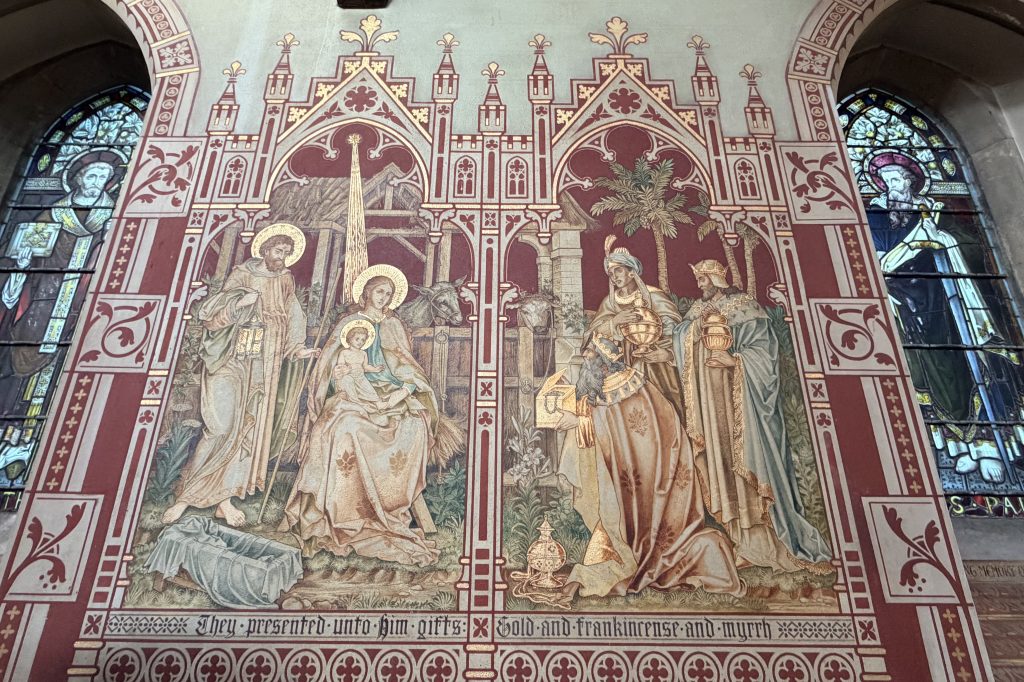
The image in this post is of one of the wall paintings in the church where I am a priest, St. Andrews N16. They are deeply unique, and the photo does not do them justice.
Wishing you a blessed and peaceful Christmas, where I pray you feel known and loved by God.
 Ruth Greenaway-Robbins
Leave a comment