
Act 9:1-22 | Galatians 1:11-16b
I wonder if you have ever known someone who has had what we might call a Damascus moment – a moment where a way of life, a settled belief, or a deeply held view has been radically interrupted, and they have turned another way altogether.
In the Acts of the Apostles, we read about the Damascus moment: Saul, breathing threats and violence, stopped in his tracks by a blinding light, a voice from heaven, and a complete upending of his life.
And yet, when I look at my own life – and at the lives of those I know and love – I see change, sometimes profound change, but rarely in a single flash-bang, whollop moment like Paul’s. More often, conversion happens slowly: over weeks, months, sometimes years. A gradual turning. A series of returns.
That matters, because in the world we live in, changing your mind is often seen as a weakness. If a government changes course, the media quickly cries, “U-turn!” as though turning towards truth, or justice, or the needs of others were something to be ashamed of. There is very little grace in that way of thinking.
Scripture, however, tells a very different story.
The remarkable thing about St Paul is not simply that he changes his mind, but how completely he turns. On the road to Damascus, he goes from being a devout, observant Jew, utterly convinced he is doing God’s will by persecuting the followers of Jesus. To a man who gives his whole life to Christ, risking reputation, safety, and eventually his life.
Saul becomes Paul.
Persecutor becomes preacher.
Certainty gives way to surrender.
As the lyrics from Wicked put it rather beautifully – he is, quite literally, “changed for good.”
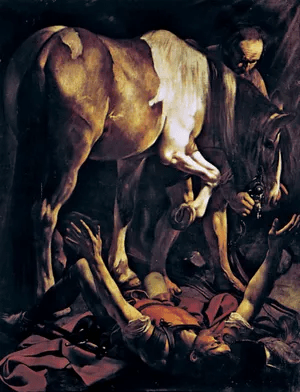
The Conversion of St. Paul by the 17th-century painter Caravaggio.
Now, it would be easy today to get caught up in the complexities of Paul’s writings – and let’s be honest, they are complex. What Paul says particularly about women’s role in the Church and about sexuality requires careful, prayerful, contextual reading. Scripture is never just about what’s on the page; it’s about who it was written to, why, and how it is received in the light of Christ.
And yet, Paul also gives us some of the most profound, moving, and shaping words of the Christian faith. I cannot tell you how often, I am caught unexpectedly by something he writes and find myself close to tears. His words encourage us, challenge us, remind us that nothing can separate us from the love of God in Christ Jesus.
But this feast isn’t really about untangling Paul’s theology.
This feast is about conversion.
About turning.
And about returning.
In our reading from Galatians, Paul tells his own story in a quieter, more reflective way. He speaks of being ‘set apart’, of God revealing his Son to him, not because he earned it, not because he deserved it, but because of grace. Paul comes to understand that his life, even with all its violence and error, is not beyond God’s redeeming love.
That, too, is conversion.
On Friday night, I went to the Barbican to hear the BBC Symphony Orchestra. The programme opened with Copland’s Appalachian Spring – a piece I’ve loved for years but don’t recall ever hearing live. Towards the end, Copland weaves in a Shaker hymn you’ll probably recognise, especially if you know Lord of the Dance.
The hymn is called Simple Gifts, and these are its words:
‘Tis the gift to be simple, ’tis the gift to be free
’Tis the gift to come down where we ought to be,
And when we find ourselves in the place just right,
’Twill be in the valley of love and delight.
When true simplicity is gained,
To bow and to bend we shan’t be ashamed,
To turn, turn will be our delight,
Till by turning, turning we come ’round right.
I used to sing this hymn often, and I have taught it to many students, especially during my time in Canada. And every time I hear it, I’m struck by those words:
“To turn, turn will be our delight.”
Because that is the heart of conversion, not striving upwards, not grasping for certainty or control, but coming down. Choosing humility. Choosing freedom. Learning to pay attention to where God has placed us.
True discipleship, like true conversion, is not about self-importance. It is about learning to live lightly, to love deeply, and to stand honestly before God and one another.
The “simple gifts” the Shaker hymn names are not small or naïve. They are holy gifts:
the gift of freedom that comes from letting go,
the gift of humility that allows us to bow without shame,
the gift of repentance and transformation – of turning and returning – until our lives are aligned again with God’s way of love.
And here is the extraordinary thing: when we turn and return towards God, God delights in it.
A couple of weeks ago, on the Feast of the Baptism of Christ, we heard those words spoken over Jesus:
“You are my beloved Child; in you I am well pleased.”
God delights in us – not because we are perfect, but because we are God’s.
That is why, in our service booklets in St. Andrews, the time of confession is called “Returning to God.” Confession is not about shame or punishment. It is about coming home. About naming what is broken, apologising – to God, to one another, and sometimes to ourselves – and allowing ourselves to be forgiven.
Paul had to do that too. He had done terrible things in the name of God. He had to repent. But he also had to learn, perhaps even more painfully, that he was still loved. Unconditionally.
In Acts, Paul’s conversion interrupts everything. He is stopped mid-stride, mid-sentence, mid-certainty. He is plunged into darkness before he can see again. And when his sight is restored, his life is never the same.
From that moment on, he knows suffering: physical frailty, persecution, rejection, and the deep inner tension of holding his Jewish identity alongside the revelation of Christ crucified and risen.
Turning and returning are not easy.
Scripture is honest about that, from the thief on the cross, to the Samaritan woman at the well, to the thousands who turn at Pentecost. Conversion brings joy and purpose, yes, but it also brings cost.
To follow Jesus is to commit ourselves to justice, mercy, and forgiveness, even when it is uncomfortable, even when it asks something real of us.
But let’s be clear, conversion is not only a single dramatic moment; it is also something daily. It is a constant attentiveness to returning to God. The New Testament word metanoia means a change of heart, a turning around, and this turning is part of our everyday discipleship. In the Benedictine tradition this is called conversatio morum – conversion of life – a commitment to ongoing transformation, noticing where we have drifted, and choosing, day by day, to turn back toward God.
So, we give thanks for the conversion of St Paul.
And we give thanks for the moments of conversion in our lives – however dramatic or gentle they may have been. The everyday and the moments like Damascus.
For some, there have been blinding lights.
For others, a slow dawning.
Both are holy. Both are real.
And yet, the real work comes when we do the daily work of conversion.
And finally, I want to encourage us to examine our lives and ask:
Where might Christ be calling us to turn again?
In our relationships?
In our vocation?
In our life together as the Church – whatever you context might look like, and in the wider body of Christ?
Because the good news is this:
Turning is not failure.
Returning is not weakness.
Grace upon Grace is in the returning.
“To turn, turn will be our delight,
till by turning, turning,
we come ’round right.”
Amen.
I thought it might be nice to share a simple and yet beautiful recording of this hymn sung by the Mezzo Soprano Clara Osowaski
 Ruth Greenaway-Robbins
Leave a comment