
Matthew 17:1–9 | Exodus 24:12–end | Psalm 99
Have you ever had a moment when something you thought you understood suddenly became clear in an entirely new way? Not because the facts changed – but because your perception did. A conversation, an encounter, a piece of music, a prayer – and suddenly you see and understand differently.
These moments do not just give us information. They change us.
I had one of those moments with GCSE Maths.
I struggled profoundly with Maths at school. I was in one of the bottom sets. I failed my GCSE the first time. I took it again – and failed again, this time with a lower grade. As the third sitting approached, I felt dread rising in me.
Then a friend of my mum’s, we’ll call her Jane, offered to help. For a few intense days, she sat with me and explained things differently. It was like someone slowly turning the lights on in a pitch-black room. What had been flat and incomprehensible suddenly had shape and colour. The maths hadn’t changed – but my understanding had. I began, astonishingly, to enjoy it.
I passed in June 1997.
To this day, after degrees and many other exams and qualifications, GCSE Maths is the one I am most proud of. It was hardest won. And it changed how I understood learning – and myself. It left me less fearful of numbers and more attentive to patterns and beauty.
Those “a-ha” moments matter.
A Mountain of Light
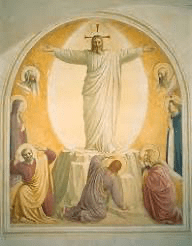
On Transfiguration Sunday, the Church reads the account of Jesus taking Peter, James and John up a mountain to pray (Matthew 17:1–9). There, he is transfigured before them. His face shines like the sun. His clothes become dazzling white. Moses and Elijah appear, speaking with him.
It is a moment of unveiled glory.
But it is not spectacle for spectacle’s sake.
It is preparation.
Because immediately afterwards, Jesus turns towards Jerusalem – towards suffering and the cross. Before the descent into darkness, there is a glimpse of light.
That pattern echoes the reading from Exodus (Exodus 24:12–end), where Moses ascends Mount Sinai. The cloud covers the mountain, and the glory of the Lord settles there. In Scripture, the cloud is not confusion; it is holy presence – God revealed and hidden all at once.
Psalm 99 recalls that God spoke to Moses and Aaron from the pillar of cloud. The holy God is not distant. He is relational. He speaks.
And on the mountain of Transfiguration, God speaks again:
“This is my Son, the Beloved… listen to him.” (Matthew 17:5)
Not admire him.
Not analyse him.
Not preserve the moment.
Listen to him.
Peter’s instinct is to build shelters – to capture the glory and stay there. But faith is not about clinging to the mountaintop. It is about allowing what we glimpse of Christ to reshape how we live when we come back down.
Because they do come down the mountain.
And they are immediately met with need, confusion, and human struggle. Glory does not remove them from the world. It prepares them for it.
A Hinge Before Lent
Transfiguration Sunday stands as a hinge in the Christian year. It offers a steadying light before Lent begins – before the Church walks intentionally towards the events of Holy Week and Easter.
Lent is sometimes misunderstood as a religious self-improvement scheme. Give up chocolate. Improve your habits. Reset your willpower.
But historically and spiritually, Lent is something deeper: an invitation to transformation – in our relationship with God, with ourselves, and with our neighbour.
How we begin Lent shapes how we arrive at Easter.
If we rush in lightly, Easter becomes a date in the diary.
If we attend deeply – whether through prayer, reflection, or simply a willingness to listen – Easter may find us changed.
In our parish, we will be having a Lent study group called “Keeping Holy Time.” Together we will explore the great holy season of Lent and Holy Week. Each week we will look at a different liturgy or day so that we can join in and fully understand each liturgy. We will explore Scripture, tradition, and the Church’s worship – how they shape us over time.
Alongside that, I will post a sermon each week reflecting these themes:
- Lent 1: Lent and Ash Wednesday
- Lent 2: Palm Sunday
- Lent 3: Maundy Thursday
- Lent 4: Good Friday
- Lent 5: Holy Saturday and beyond
Whether you are a regular churchgoer, an occasional visitor, or simply spiritually curious, you are welcome to read along here each week. The rhythms of the Christian year are not closed spaces; they are invitations.
Remembering and Participating
Holy Week places Christians in what theologians might call a liminal space – a threshold. We are not simply re-enacting past events. Nor are we spectators remembering something distant.
In Christian worship, remembering is participatory.
When we hear the words, “This is my body,” echoing Jesus’ words at the Last Supper (Matthew 26:26), we are not only recalling a historical meal. We believe we are being drawn into that self-giving love in the present moment.
When we kneel on Good Friday and turn towards the crucifixion, we are not simply observing tragedy. We are invited to place our own lives – the broken, the hidden, the shame – before the cross.
We stand in the doorway between what Christ has accomplished and what is still unfolding in us and in the world.
Lent invites us learn how to stand there.
Transformation, Slowly
Transformation is rarely dramatic. Look at the baroness of winter turning to spring; it is slowly transforming, but it is very slow.
It may look like honesty in prayer.
Like allowing God to speak into places we usually keep guarded.
Like confronting truth with courage.
Psalm 99 holds holiness and forgiveness together. God is holy and God forgives. Holiness is love that takes truth seriously.
Often change is gradual. Like light slowly filling a darkened room. The subject does not change but we learn to see differently.
The disciples did not fully understand what they witnessed on the mountain. The Gospel of Matthew tells us they fell to the ground in fear (Matthew 17:6). But something shifted in them. The light they glimpsed would steady them later.
Perhaps that is what Transfiguration Sunday offers: a glimpse of who Christ truly is, before the long road to the cross.
“This is my Son, the Beloved… listen to him.”
If we listen – truly listen – over these weeks…
If we allow Scripture and prayer to do their quiet work…
If we step, however tentatively, into the holy rhythm of the holy liturgies of Lent, Holy Week, and eventually Easter.
Then Easter will not simply be a celebration of resurrection as an idea.
Instead, it may become an experience of resurrection in us.
Because Lent is not about what we give up.
It is about who we become.
Perhaps faith is a little like that GCSE Maths for me – the truth has been there all along, but sometimes we need the light to fall differently before we can see its beauty. Lent does not change the facts of God’s love, but it can change our understanding, until what once felt distant or confusing becomes something we recognise as life-giving and true.
On Transfiguration Sunday, we stand on the mountain edge.
Before us lies the journey.
Before us lies Ash Wednesday.
Before us lies Holy Week.
Before us lies resurrection.
How we begin will shape how we arrive.
So let us listen.
And let us be changed.
 Ruth Greenaway-Robbins
Leave a comment