
Genesis 2:15–17; 3:1–7 | Psalm 32 | Matthew 4:1–11
Keeping Holy Time
This Lent at St. Andrews N16, and in our partnership with St. Mary’s N16, we are journeying together through the theme “Keeping Holy Time.” Week by week, we are exploring the great days of this season – from Ash Wednesday and Lent itself, through Palm Sunday, Maundy Thursday, Good Friday, and Holy Saturday.
To keep holy time is to allow the story of Christ’s passion and resurrection to shape us slowly and prayerfully. The Church gives us this season and these days not to rush through, but to inhabit – to repent, to watch, to wait, and ultimately to hope. As we return to these sacred moments together, may they form us more deeply in the life and love of Christ.
This week we begin our Lent journey together – alongside our study group – Keeping Holy Time exploring the season of Lent and Ash Wednesday.
And perhaps the simplest question is this:
Why?
Why keep a holy Lent?
Why ashes?
Why fasting?
Why this annual return to wilderness?
Because Lent can so easily become thin.
Either a religious self-improvement programme –
“New Year, but holier.”
Or a manageable sacrifice –
“I’ll give something up,”
and quietly count the days until Easter.
But the Church is inviting us into something far deeper.
She is inviting us to step back into the story.
The Garden
Genesis takes us to the beginning.
A garden.
A place of abundance.
Of beauty.
Of intimacy with God.
Adam and Eve are given everything they need.
Only one boundary.
One tree.
And the serpent’s voice is subtle:
“Did God really say, you shall not east of ?”
The first temptation is not about fruit.
It is about trust.
And notice how the fruit is described:
Good for food.
A delight to the eyes.
Desirable to make one wise.
Appetite.
Possession.
Pride.
And when they take it – when they grasp – something shifts.
“Their eyes were opened…
and they hid.”
Sin leads to concealment.
They sew fig leaves.
They withdraw.
They blame.
The first human instinct after failure is not confession.
It is hiding. And that is hard to hear and to accept.
Psalm 32 tells us that instinct has never left us.
“While I kept silence, my body wasted away.”
Silence.
Covering.
Concealment.
We manage our image.
We curate ourselves.
We keep certain things tucked away.
And Lent begins by interrupting that.
Ash Wednesday: Truth Without Drama
On Wednesday, we stood in a very simple liturgy.
No Gloria.
No flourish.
Just Psalm 51.
Just Joel’s cry: “Return to me.”
Just the stark words: “Remember that you are dust.”
In fact some of us noted at the end that we felt it was deeply meditative.
Lent’s liturgy is stripped back.
Purple.
Plain.
Scripture-heavy.
And did you notice how much of it draws from the Old Testament?
Joel.
The Psalms.
Genesis.
The prophets.
It is as if the Church takes us by the hand and says:
Before we rush to resurrection,
remember the story.
Ashes, as the tradition reminds us, are deeply biblical.
They are a sign of mortality – dust to dust.
They are a sign of repentance – like Job.
They are a sign of intercession – like Daniel and Esther.
They are not theatrical.
They are truthful.
They say:
I am mortal.
I have fallen.
I need mercy.
But here is the quiet wisdom of the Church.
Ash Wednesday is public.
But Lent is hidden.
Jesus tells us:
When you fast.
When you pray.
When you give.
Not if.
And not to be seen.
The ashes mark us once.
The deeper work happens in secret.
“Rend your hearts, not your garments.”
Lent is not about spiritual performance.
It is about interior truth.
The Desert: A Second Beginning
Then today this first Sunday in Lent we are taken somewhere else.
From garden to desert.
Matthew tells us:
Jesus is led by the Spirit into the wilderness.
He is not lost.
He is led.
The desert is not punishment.
It is preparation.
And there, in the wilderness, the same three distortions appear again.
“Turn these stones to bread.”
Appetite.
“All the kingdoms of the world will be yours.”
Possession.
“Throw yourself down.”
Pride.
The same pattern as Eden.
But this time something different happens.
Jesus does not grasp.
He does not justify.
He does not hide.
He answers with Scripture.
Notice that.
Not argument.
Not bravado.
Scripture.
“Man shall not live by bread alone.”
“You shall worship the Lord your God.”
“You shall not put the Lord your God to the test.”
In Genesis, humanity reaches for autonomy.
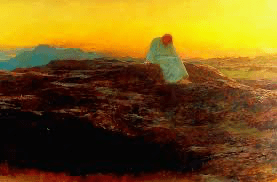
In Matthew, Christ leans into obedience.
In the garden, humanity hides.
In the desert, Christ stands.
The desert becomes a kind of second beginning.
The Wilderness We Know
And the wilderness is not always dramatic.
It doesn’t always look like sand and stones.
Sometimes it looks like exhaustion and overwhelm.
I know in my own life, when I have been stretched thin personally, professionally, or spiritually, that I feel I need to rely on myself to get through.
These are seasons when I realised how quickly I reached for something to steady myself. Achievement. Approval. Control.
And that is wilderness.
It is the place where we discover what we lean on.
What we reach for when we are hungry, not just for food, but for reassurance.
And Lent invites us there.
Not to shame us.
But to show us what is underneath and what needs work.
What Lent Is For
So, what is the purpose of keeping a holy Lent?
It is not self-denial for its own sake.
It is re-ordering love.
Genesis shows us disordered love.
Psalm 32 shows us the ache of concealment.
Matthew 4 shows us another way.
Fasting loosens the grip of appetite.
Almsgiving loosens the grip of possession.
Prayer loosens the grip of pride.
Not because these things are evil.
But because they easily become ultimate.
And when they become ultimate, we hide.
But listen again to Psalm 32:
“I acknowledged my sin to you…
and you forgave.”
The psalm moves from concealment to joy.
“Happy are those whose transgression is forgiven.”
Lent is not about rehearsing how bad we are.
It is about discovering how freeing honesty can be.
The ashes tell the truth.
The desert teaches trust.
The psalm sings forgiveness.
Keeping Holy Time
This is what we mean by Keeping Holy Time.
We are not just marking days on a calendar.
We are stepping into the deep scriptural story.
The Church slows us down.
Removes the Gloria.
Let’s silence breathe.
Fills our ears with prophets and psalms.
And gently asks:
Will you stop hiding?
Will you trust me in the wilderness?
Will you let me re-order what you love?
Because without intentional time, we drift.
Lent is choosing not to drift.
Choosing to walk from garden to desert.
Choosing to move from concealment to confession.
Choosing to stand with Christ when temptation whispers.
And discovering that the God who walked in the garden at the beginning
still walks towards us now.
Not to condemn.
But to clothe.
Not to shame.
But to restore.
And so, this first Sunday of Lent, just beyond the ashes, we hear again the invitation:
Return to me.
Trust me in hunger.
Trust me in testing.
Trust me in mortality.
And discover that the desert is not the end of the story.
It is the place where obedience grows.
 Ruth Greenaway-Robbins
Leave a comment