
Lectionary Readings for Lent 3: Exodus 17: 1-7 | Psalm 95 | John 4: 5-42.
As some of you may know, I have come to London via Wales, via Cardiff. Cardiff has been woven into my life since my early twenties, and that stitching began when I went there to study singing at the Royal Welsh College of Music and Drama in 1999.
At college, we performed in many wonderful places; St David’s Hall, later the Millennium Centre, but the place we loved most was Llandaff Cathedral.
Llandaff is ancient and wounded. Medieval in its foundations yet heavily bombed in the Second World War. Much of it had to be rebuilt. And as part of that rebuilding, the sculptor Jacob Epstein was commissioned to create something that would speak of devastation and hope.
What he created was extraordinary and controversial. A vast 16-foot Christ in Majesty, suspended above the nave on a great concrete arch. Concrete against ancient stone. It is still something of a Marmite sculpture.
But as performers, we sat directly beneath it. And from where we sat, you could not see Christ’s face.
All you could see were his hands.
And his feet.
It fascinated me.
Nearly twenty years later, I found myself kneeling beneath those same hands and feet. First, as a sub-deacon on Maundy Thursday during my training. Later, as I was ordained deacon. And then priest.
Those hands and feet I once gazed upon now seemed to gaze upon me.
And that image has never left me.
As Teresa of Ávila writes, “Christ has no body now on earth but yours. No hands, no feet but yours.”
But what does that mean?
What does it mean as we arrive, in this journey of Keeping Holy Time, at Maundy Thursday – a day that is, at its heart deeply embodied, and all about hands and feet?
Because on that night:
Hands take bread.
Hands bless.
Hands break.
Hands give.
And then those same hands tie a towel, kneel down, and wash feet.
Maundy Thursday is not abstract theology.
It is hands and feet.
Today our readings from the lectionary speak of bodies.
In Exodus, the people thirst in the wilderness. Their bodies ache. Their mouths are dry. They cry out, “Is the Lord among us or not?” And water comes from struck rock.
In the psalm, we are invited to bow down to bend our bodies in worship.
In John’s Gospel, a woman comes to a well at midday. Jesus says to her, “Give me a drink.” What begins as physical thirst becomes something deeper, living water, welling up to eternal life.
Our physical bodies and the deep human longing to be sustained, to know that God is truly among us.
And Maundy Thursday is where that longing becomes tangible.
Because on that night, Jesus does not give a theory.
He gives something you can hold.
He places bread into human hands and says, “Do this in remembrance of me.”
He pours wine and says, “This is my blood.”
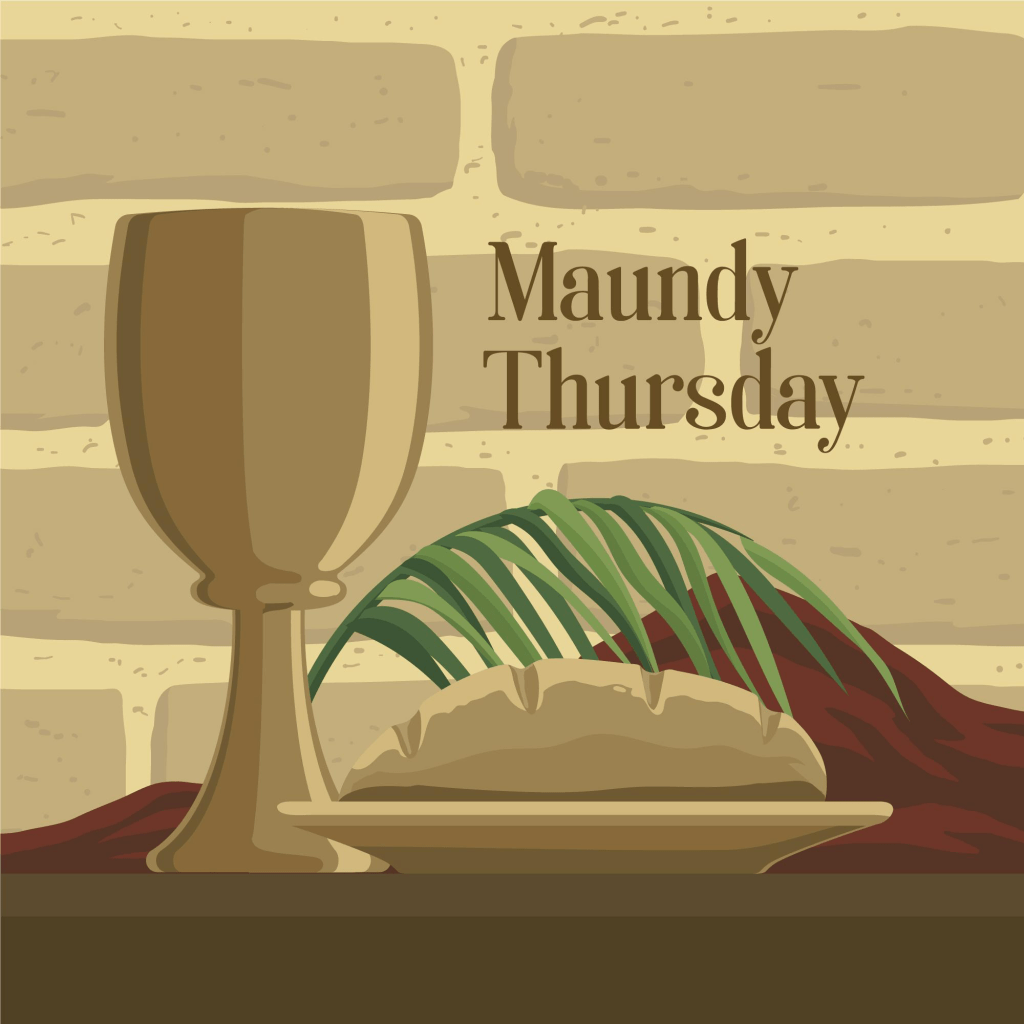
Before we can wash anyone’s feet, before we can speak of love, our hands must first open in dependence. Maundy Thursday teaches us that the Church begins not with our activity, but with receiving Christ.
Because the Last Supper was not an abstract ritual in a vacuum. It was a meal among friends. Bread passed hand to hand. Cups shared. Feet dusty from walking.
The woman at the well came with an empty jar and left overflowing.
On Maundy Thursday, we come with empty hands and Christ fills them.
But the night does not end at the table.
John’s Gospel that we hear at many churches on Maundy Thursday does not give us the familiar words over bread and wine. Instead, it gives us a basin and a towel.
Jesus rises from supper.
He removes his outer garment.
He kneels.
The hands that broke bread now wash feet.
Dusty feet.
Tired feet.
Vulnerable feet.
Peter recoils – and perhaps we do too. Bread feels safe. But this is personal. This is exposing. This asks something of us.
“Unless I wash you,” Jesus says, “you have no share with me.”
Maundy Thursday is not first about what we do for Jesus.
It is about what he does for us.
He kneels before our dust.
He touches what we would rather keep hidden.
He serves without hesitation.
And only then comes the commandment – the mandatum:
“Love one another as I have loved you.”
Not as you find convenient.
Not as you feel inclined.
As I have loved you.
Love with hands.
Love at ground level.
Love that feeds and washes and stays.
And then, slowly, the mood changes.
After the meal, after the washing, after the hymn, they go out into the night.
The Church, from its earliest centuries, has understood this as a night not to rush. A night to linger in the story. A night when the atmosphere shifts.
We strip the altar.
We remove the cloths as it were of the church.
We take away the vessels.
We leave the sanctuary bare.
The hands that received bread now remove it.
The hands that shared fellowship now prepare the church for absence.
It is a physical act of transition.
The warmth of the meal gives way to the starkness of Good Friday.
The church is made ready for the day when Christ will hang stripped and exposed.
Maundy Thursday is the hinge between companionship and abandonment.
It is the night the Church learns whether it will stay not necessarily in prolonged silence, but in faithful participation.
To stay in the story.
To stay with the discomfort.
To stay when the atmosphere darkens.
In Exodus, the people wondered if God was truly among them.
In John, the woman discovered that God was standing in front of her, asking for a drink.
On Maundy Thursday, God kneels before us.
And by Good Friday, he will say, “I thirst.”
The needs and experiences of our bodies runs both ways.
Psalm 95 urges us, “Today, if you hear his voice, do not harden your hearts.”
Maundy Thursday is a softening night.
It softens our hands – from clenched to open.
It softens our pride – from standing to kneeling.
It softens our fear – from stepping back to stepping closer.
Because this is not a week for spectators.
This deep embodiment.
To gather.
To eat together.
To receive.
To kneel.
To watch the altar stripped.
To return on Friday.
To wait on Saturday.
Maundy Thursday teaches us so much about being the Body of Christ.
Hands that receive bread.
Hands that wash feet.
Hands that strip the altar.
Feet that walk into the night together.
Christ has no body now on earth but ours.
No hands but ours to break bread.
No hands but ours to wash.
No hands but ours to prepare the place of waiting.
No feet but ours to follow him into what comes next.
So, as we continue to prepare for the great week of Holy Week, I encourage us to ask ourselves gently:
Where will we be in the story?
At the table?
With the towel?
In the sanctuary as the altar is laid bare?
For the hands that broke bread,
the hands that washed feet,
are now given to us the Church
that Christ may still serve the world through us.
Amen.
 Ruth Greenaway-Robbins
Leave a comment