
Sermon for Ascension Sunday, Acts 1:1-11, Luke 24:44-end
I remember as a child struggling a little with the Ascension.
I did not naturally pick up on “the great joy” that the disciples seemed to experience after Jesus ascended into heaven.
What I noticed instead was the absence.
Jesus goes.
The disciples are left behind.
And if we take the story only at the surface level, it can feel a little like abandonment.
Almost as though the story reaches this extraordinary climax in Easter, only for Christ then to disappear again.
And perhaps if we are honest, that feeling is not entirely unfamiliar to us.
Because it is very easy, especially when life becomes difficult, when prayers seem unanswered, when suffering comes close, when the world feels uncertain or frightening, to slip into that deeply human fear:
“Have we been left alone?”
Particularly in moments of challenge.
Particularly when God feels silent.
Particularly when the world does not look much like the Kingdom of God we pray for.
Last week, I reflected about how Jesus had been preparing the disciples for precisely this moment.
Again and again in John’s Gospel, he tells them:
“I will not leave you orphaned.”
“Do not let your hearts be troubled.”
“Peace I leave with you.”
He prepares them because he knows how strong the fear of abandonment can be.
And if we are honest, even knowing the resurrection does not entirely remove that struggle.
There are still moments when God can feel distant.
Moments where heaven seems quiet.
Moments where we wonder where Christ is in the middle of grief or exhaustion or conflict or fear.
But I think the Ascension asks us to see something deeper than physical absence.
Because we know the rest of the story.
We know that Ascension is not Christ disappearing from the world.
It is Christ filling all things.
We know that what follows Ascension is Pentecost.
What appears at first to be absence becomes presence in an entirely new way through the Holy Spirit.
And perhaps this is part of why the disciples can return to Jerusalem with great joy.
Not because they fully understand everything.
Not because fear has vanished overnight.
Not because life has suddenly become easy.
But because somewhere, somehow, they trust that this is not the ending.
That God is still acting.
That Christ is still present.
That the story is still unfolding.
And we, unlike the disciples in that moment, know what is coming next.
We know that the Holy Spirit will descend upon frightened disciples and turn them into courageous witnesses.
We know that the Church will be born.
We know that the Gospel will travel across languages and nations and centuries.
We know that Christ’s presence will no longer be limited to one body standing in one place before them, but that through the Holy Spirit Christ will dwell within his people.
Not only beside them,
but within them.
Not simply leading them from the front,
but empowering them from within.
And that changes the meaning of Ascension entirely.
Because the Ascension is not about Jesus abandoning the world.
It is about Christ no longer being bound by the limitations of earthly presence.
No longer confined to Galilee or Jerusalem.
No longer accessible only to those physically near him.
But reigning over all things,
holding all things,
drawing all things toward the Kingdom of God.
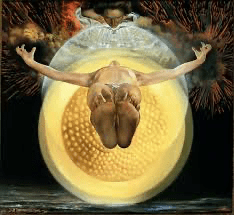
And that matters.
Because the Ascension is not simply about where Jesus is.
It is about what Jesus is now doing.
In the Ascension, Christ is enthroned.
The crucified and risen Christ reigns.
Not Caesar.
Not empire.
Not violence.
Not fear.
Not death.
Christ reigns.
And yet, if we are honest, the world does not fully look like that yet, does it?
Which is why the days between Ascension and Pentecost matter so much.
Because the disciples find themselves living in this strange in-between space.
Christ has ascended.
The Spirit has not yet come.
The Kingdom has begun, but is not yet complete.
And so what do they do?
They pray.
They gather together.
They wait together.
They hope together.
And so we are encouraged as the Church between Ascension and Pentecost to live more than ever into what it means to be a praying Church.
And this is what we find oursleves doing as a parish right now.
Between Ascension Day until Pentecost we are intentionally praying for our parish, street by street, neighbour by neighbour, for all of our community.
Because these days are understood as days of praying for the coming of God’s Kingdom.
We follow the example of the disciples waiting for the fulfilment of Christ’s promise.
And while they waited, they prayed.
Not passively.
Not because prayer is all they could do.
But because prayer is participation in the Kingdom that is coming.
Prayer becomes an act of hope.
And so, every time we pray:
“Your Kingdom come, your will be done, on earth as it is in heaven,”
we are praying an Ascension prayer.
We are praying that the reign of Christ may become visible here.
In our streets.
In our homes.
In our schools.
In our local businesses.
Among neighbours.
Within families.
Within the Church.
Across nations.
We are praying for justice where there is injustice.
Peace where there is division.
Healing where there is pain.
Hope where people feel forgotten.
Because Ascension tells us that heaven and earth are no longer separate realities.
In Christ, heaven has opened toward the world.
And now the Church waits and prays for the Spirit who empowers us to live as signs of that Kingdom.
And perhaps this is also why the angels ask the disciples:
“Why do you stand looking up toward heaven?”
It is a great question, or rebuke!
Because Christianity is never meant to become an escape from the world.
It is a reminder to us and them.
The disciples cannot remain standing still, staring upwards forever.
Instead, they are sent back into Jerusalem.
Back into community.
Back into prayer.
And soon,
back into mission.
The Ascension does not remove them from the world.
It sends them more deeply into it.
And perhaps that is true for us too.
The Ascension calls us not to withdraw from the pain of the world, but to live within it differently.
To become people shaped by the Kingdom of God.
People who pray.
People who hope.
People who trust that Christ remains present even when we cannot always see clearly.
And perhaps this is where I have slowly come to love the Ascension more deeply than I did as a child.
Because now I no longer hear it primarily as a story of Jesus leaving.
I hear it as the story of Christ drawing humanity into the life of God.
I hear it as the promise that the risen Christ reigns over all things.
I hear it as the beginning of the Church learning to live by faith, hope, and the power of the Holy Spirit.
And perhaps most importantly:
I hear it as the reminder that absence is not the same as abandonment.
Christ has not left his Church alone.
The Spirit is coming.
The Kingdom is unfolding.
And so, in these days between Ascension and Pentecost, we pray.
We pray with expectation.
We pray with longing.
We pray for all people in our parishes.
We pray for our communities.
We pray for the coming of God’s Kingdom.
And we trust that even now, often quietly, often slowly, the Holy Spirit is already moving among us.
Amen.


Leave a Reply