
Matthew 9.9–13, 18–26 & Romans 4.13–25
We live in a culture that appears to admire strength.
We celebrate confidence, success, resilience, and independence. We are encouraged to put our best selves forward, to project competence, to keep going no matter what. And while there is much that is good in courage and perseverance, it can leave us with the impression that weakness is something to hide.
When we experience illness, grief, anxiety, exhaustion, uncertainty, or doubt, it can feel as though we have somehow failed. We may even imagine that these things make us less faithful.
But the Gospel we have heard today tells a very different story.
Because at the heart of this Gospel are people who are fragile.
Matthew the tax collector is not a model citizen. He is an outsider, distrusted by his neighbours and looked down upon by the religious authorities. The woman with the haemorrhage has lived with illness for twelve long years. The ruler comes carrying the grief and fear of a dying daughter. And the little girl herself is utterly helpless.
None of them appear strong.
None of them have everything together.
Yet each of them encounters the transforming presence of Christ.
Perhaps one of the most beautiful things about these stories is that Jesus does not seem remotely put off by human fragility.
In fact, he seems drawn towards it.
Take Matthew.
Jesus walks past the tax booth and sees a man whom others have already judged. The Pharisees see a sinner. A collaborator. Someone to avoid.
Jesus sees a disciple.
And with two simple words, “Follow me,” Matthew’s life changes forever.
Jesus does not wait for Matthew to improve himself first. He does not ask him to prove his worthiness. He does not demand that he sort his life out before becoming a disciple.
He simply calls him.
And Matthew responds.
Then Jesus sits down to eat with tax collectors and sinners, provoking outrage from the religious leaders.
“Why does your teacher eat with tax collectors and sinners?”
It is a revealing question.
Because they assume holiness means keeping your distance from broken people.
Jesus reveals that holiness means moving towards them.
“I have not come to call the righteous, but sinners.”
Again and again, throughout the Gospels, we find Jesus crossing boundaries that others are unwilling to cross.
And nowhere is that clearer than in the two healing stories that follow.
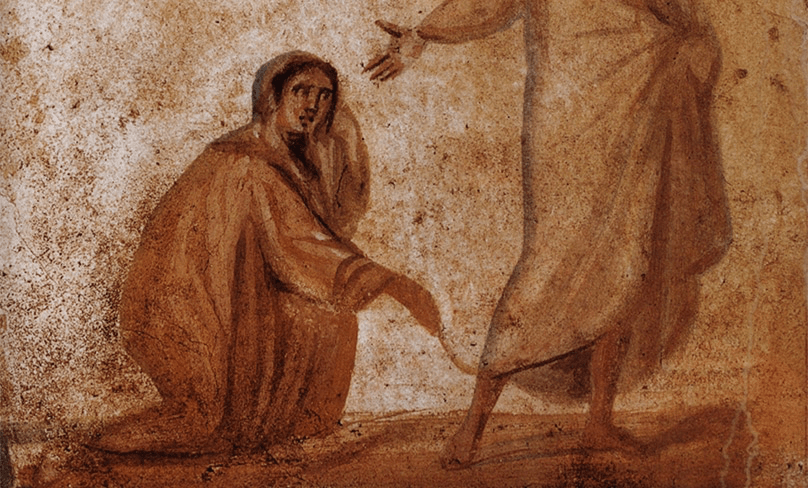
The woman who approaches Jesus has been suffering for twelve years. Twelve years of pain. Twelve years of disappointment. Twelve years of living with a condition that, according to the religious customs of the time, rendered her ritually unclean.
That word “unclean” can sound strange to modern ears, but its consequences were very real. Her condition would have affected her participation in worship and community life. She lived not only with illness but with exclusion.
And notice how she approaches Jesus.
She does not come boldly.
She does not stand before him and make a great declaration of faith.
She slips quietly through the crowd.
She reaches out and touches the fringe of his cloak.
There is something deeply human about that moment.
Because her faith does not look triumphant.
It looks fragile.
Tentative.
Almost hidden.
And yet Jesus honours it.
“Daughter, take heart; your faith has made you well.”
I think we often misunderstand faith.
We imagine faith means certainty. We imagine faith means never doubting, never questioning, never struggling.
But that is not what we see here.
The woman’s faith is mixed with fear.
The ruler’s faith is mixed with grief.
Abraham’s faith, which Paul celebrates in Romans, was mixed with years of waiting and wondering how God’s promises could possibly come true.
Faith is not the absence of fragility.
Faith is what survives within fragility.
Faith is not always a confident declaration.
Sometimes it is simply reaching out a trembling hand.
And perhaps that is good news for many of us.
Because most of us know what it means to be fragile.
Some of us carry physical illness.
Some of us carry grief.
Some of us live with anxiety or depression.
Some of us are exhausted by caring responsibilities.
Some of us are worried about money, family, relationships, or the future.
Some of us carry doubts they scarcely dare speak aloud.
And if we are honest, most of us spend at least part of our lives feeling more like the woman reaching through the crowd than a spiritual giant.
The good news of this Gospel is that Jesus does not demand perfect faith.
He receives the faith we have.
However small.
However fragile.
However uncertain.
And there is the remarkable detail that both these stories involve people whom others would have avoided.
The woman’s condition made her ritually unclean.
The little girl is dead.
According to the customs of the time, touching either would make someone unclean.
The assumption was that uncleanness spreads.
Yet when Jesus enters the story, something extraordinary happens.
The direction is reversed.
The woman touches Jesus.
Jesus takes the little girl by the hand.
But their uncleanness does not flow into him.
His life flows into them.
His healing flows into them.
His wholeness flows into them.
Jesus crosses the boundary.
He moves towards suffering rather than away from it.
Towards grief rather than away from it.
Towards fragility rather than away from it.
And perhaps that tells us something profound about God.
So often we fear that our weakness somehow pushes God away.
We may imagine we must present our strongest selves before God can use us or love us.
Yet the Gospel tells another story.
The God revealed in Jesus Christ is not frightened by our wounds.
Not frightened by our doubts.
Not frightened by our illness.
Not frightened by our grief.
Not frightened by our fragility.
Indeed, these are often the very places where we discover God’s presence most deeply.
Not because suffering is good.
Not because illness is holy.
But because God does not abandon us there.
Paul captures this beautifully in Romans when he speaks of Abraham trusting in the God “who gives life to the dead and calls into existence the things that do not exist.”
That is exactly what we see in today’s Gospel.
Jesus sees a disciple where others see a sinner.
He sees hope where others see only illness.
He sees life where others see death.
Again and again, Christ brings life from places that seem exhausted, broken, or beyond repair.
And he continues to do so today.
So perhaps the invitation of this Gospel is not to become stronger.
Perhaps it is not to have more certainty.
Perhaps it is simply to bring ourselves honestly before God.
To bring our doubts, our fears, our questions, our hopes.
To reach out, however tentatively, towards Christ.
For our salvation does not depend upon the strength of our faith, but upon the faithfulness of God.
And so we need not fear our fragility.
For the Christ who called Matthew, who welcomed the woman, and who took the little girl by the hand, still comes to us today.
Not demanding perfection.
Not waiting for certainty.
But meeting us with mercy, and bringing his life into all those places we feared were beyond hope.
For he has never been afraid of human weakness.
Indeed, he meets us there.
And having met us there, he does not leave us unchanged.
Amen.
 Ruth Greenaway-Robbins
Leave a comment