
Ninth Sunday after Trinity | Isaiah 55.1–5; Matthew 14.13–21
There are moments when the needs of the world before us simply feel too great.
We look at what is being asked of us personally, as a Church and as a society, and then at what we have in our hands, and the gap between the two seems impossible.
I suspect that is something of what the disciples feel in today’s Gospel.
The day is drawing to an end. They are in a deserted place, a long way from anywhere. A huge crowd has gathered around Jesus, and the people are tired and hungry.
So, the disciples make a perfectly sensible suggestion:
“Send the crowds away so that they may go into the villages and buy food for themselves.”
There is nothing particularly uncaring about their response. They have noticed the problem. They are simply being realistic.
We cannot feed all these people.
We do not have the resources.
Send them somewhere else.
But Jesus replies:
“They need not go away; you give them something to eat.”
And suddenly the problem is placed back into their hands.
It is worth noticing where this story begins. Jesus has withdrawn after hearing that John the Baptist has been brutally killed.
Jesus has come away carrying grief. Perhaps he wants silence and time to pray and mourn. Yet when he comes ashore, the crowd is already there.
And Matthew tells us that when Jesus sees them, “he has compassion for them.”
This does not mean that grief and exhaustion do not matter. This passage should never be used to suggest that faithful people must ignore their limits or meet every demand placed upon them. Jesus himself sought space to withdraw.
But it tells us something profound about God.
Jesus does not minister as one untouched by pain. He looks upon this wounded and hungry crowd while carrying his own wound, and he is moved with compassion. As evening falls, he refuses to send them away.
Here our Gospel meets the invitation of Isaiah:
“Everyone who thirsts, come to the waters; and you that have no money, come, buy and eat.”
Come without money.
Come without price.
Come because you are hungry.
Come because God’s goodness is gift.
Isaiah imagines God’s kingdom as a great feast at which the hungry are welcomed and fed. Nobody must prove that they deserve a place. God’s generosity is not reserved for those who can pay, achieve or make themselves worthy.
Come, says God.
There is enough.
And there is more than enough.
But that is not what the disciples can see.
When Jesus tells them to feed the crowd, they reply:
“We have nothing here but five loaves and two fish.”
Nothing here but…
It is such a human response. In the face of such enormous need, what they have is barely worth mentioning.
But Jesus says, “Bring them here to me.”
He does not ask them to produce what they do not have or shame them for the smallness of their offering. He asks them to place what they have into his hands.
Perhaps this is where the miracle begins: with the willingness to bring what seems hopelessly inadequate to Jesus.
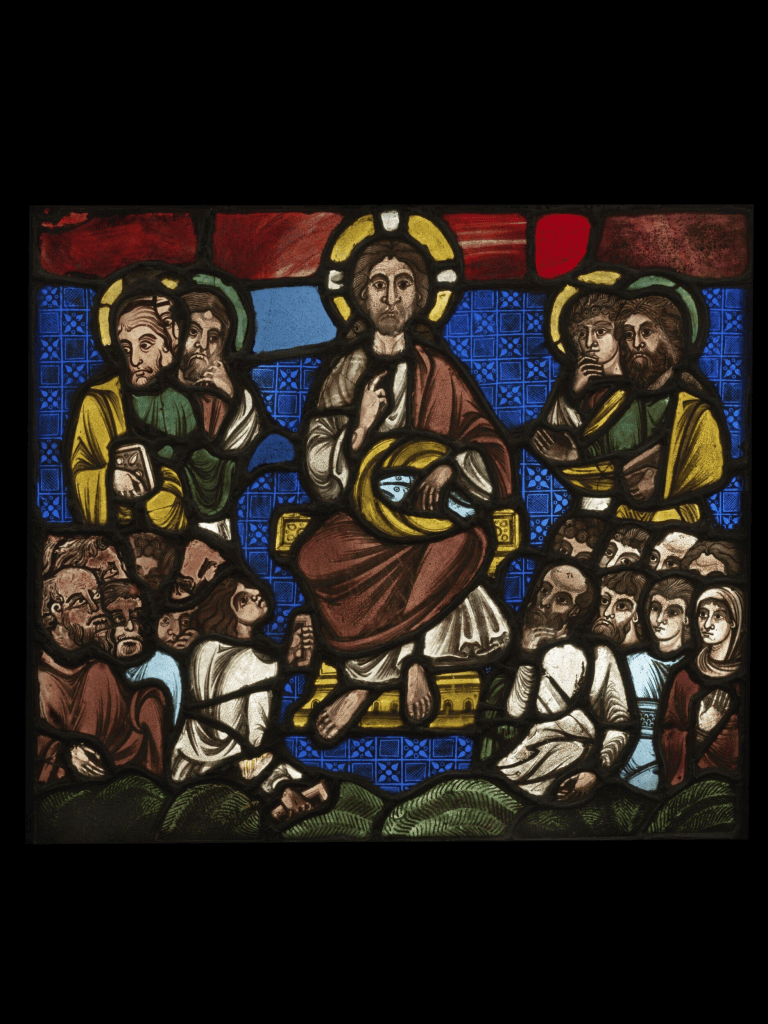
Jesus takes the bread. He looks up to heaven. He blesses it. He breaks it. And he gives it to the disciples to place before the crowd.
Takes.
Blesses.
Breaks.
Gives.
The actions point us towards this table, to the Eucharist in which Christ takes the ordinary gifts of the earth and gives himself to us.
But the setting matters too.
Jesus feeds the people in the wilderness, the place where Israel’s ancestors had journeyed out of slavery and where God had fed them with manna from heaven.
As we have been exploring in our book group through Jesus and the Jewish Roots of the Eucharist, there was a hope that when God’s saving work was renewed, the gift of manna would be renewed too.
So, when Jesus feeds the people with miraculous bread in the wilderness, he is doing more than satisfying their immediate hunger. He is revealing who he is.
Here is the one who feeds God’s people in the wilderness.
Here is the bread of the new exodus.
Here is a foretaste of God’s promised banquet.
And when the fragments are gathered, there are twelve baskets remaining, one for every tribe of Israel. In Jesus, God is feeding and gathering his people once again.
Yet the disciples are not merely spectators. The bread passes from Christ’s hands into theirs and from their hands into the hands of the crowd.
“You give them something to eat.”
Jesus draws them into his work of compassion. What they have is not enough by itself, but offered to Christ and shared at his command, it becomes part of God’s abundance.
We know something about that here at St Andrew’s. And many churches are like us.
Food has become an important part of community life together. Here at St. Andrews through the Foodbank, Community Cooking, the Conversation Café, the Community Meal we have once a month on a Sunday and the many occasions when we gather around tables.
These things are not optional extras alongside the “spiritual” work of the Church. They are signs of God’s kingdom.
Whenever food is offered freely; whenever strangers become neighbours; whenever somebody who is hungry is fed or someone who is lonely finds companionship, the kingdom draws near.
But we must not romanticise hunger. Hunger is not a metaphor to those who genuinely do not have enough to eat. The fact that Foodbanks are needed in one of the wealthiest countries in the world should trouble us deeply.
Isaiah asks:
“Why do you spend your money for that which is not bread, and your labour for that which does not satisfy?”
That is a question not only for individuals, but for our society.
Why do we accept systems in which some have far more than they need while others cannot afford to eat? Why is there always money for some things, but never enough to feed and house people, care for them or protect their dignity?
God’s kingdom is not a marketplace in which everything has a price, and only those with money may eat. It is a banquet to which God calls everyone who thirsts:
“Come, buy and eat…without money and without price.”
Yet there are other kinds of hunger too.
We can have plenty to eat and still hunger for love.
We can be surrounded by people and still hunger for companionship.
We can fill every hour and still hunger for meaning.
We can consume more and more and remain unsatisfied.
And into all those hungers, God says: Come.
Come, not because you have earned it.
Come, not because your faith is perfect.
Come because you are hungry.
Come because Christ is here.
At the end of the Gospel, everyone eats and is satisfied. And still twelve baskets remain.
Not just enough, but more than enough.
That does not mean every problem will disappear if only we have enough faith. Nor does it mean that our human resources are limitless. The Church still needs wisdom, rest, boundaries, generosity and justice.
But we should be cautious about deciding, on God’s behalf, that there cannot possibly be enough.
Perhaps the question is not, “Do we have enough?”
Perhaps it is, “What do we have that we can bring to Jesus?”
None of us can meet every need, and no one person is being asked to do so, and I have to admit this has been one of the hardest lessons as an adult, that I/we can’t fix every need before me/us. But together we can place what we have into the hands of Christ and allow him to use it.
Each week we gather at the altar, and we will come to this table with our own hungers.
We come with empty hands, and Christ places into them the gift of himself.
We come thinking there is not enough, not enough faith, strength, hope, perhaps not enough of us.
But Christ says, “Bring them here to me.”
For in the hands of Christ, what is small is not despised, what is broken is not discarded, and those who hunger are not sent away.
All eat.
All are satisfied.
And still, there is more than enough.
Amen.
 Ruth Greenaway-Robbins
Leave a comment