
A sermon preached at the Anglican Eucharist National Network of Pastoral Musicians 2026 Conference | One Heart, One Voice | Highgate House | Sunday 26th July 2026
Matthew 13.31–33, 44–52; Romans 8.26–end
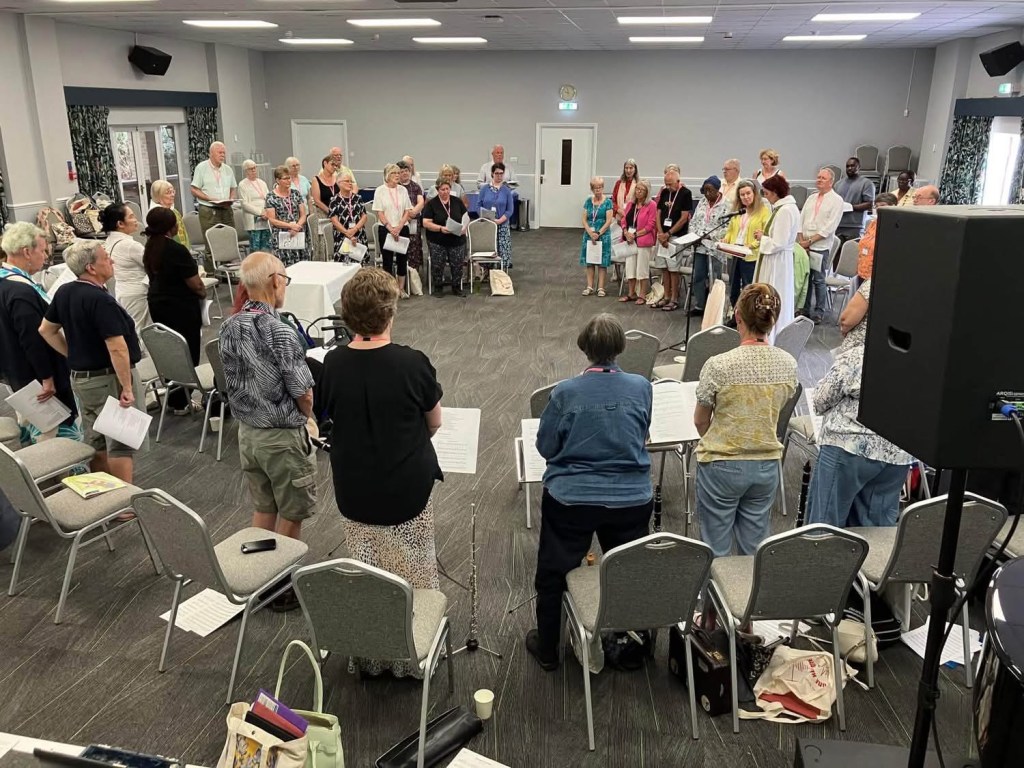
I wonder, if I were to ask you, “What, or where, is home?” what your answer might be?
Until this time last year, I was living and ministering in Wales. And in Welsh there is a word: hiraeth.
It is difficult to translate. It can mean a longing for home, but it is more than homesickness. It is a deep yearning for a place, a people, or even a time in which we feel that we truly belong.
Sometimes it is a longing for a home we once knew; sometimes for a home which may never have existed quite as perfectly as we remember it.
But perhaps hiraeth can also describe a longing for a home we have not yet known: a sense, deep within us, that the world is not yet as it should be; that there must be another way of living, in which we, and the whole of creation, can finally be at home.
And perhaps that is something like our longing for the Kingdom of God.
A wise priest once said to me, “Surely the hiraeth you are searching for is the Kingdom of God.”
Annoyingly, I think they might have been right.
Because home is a complicated question for me, as it can be for many of us. I have never lived anywhere for more than nine years. I was born in Lincoln, brought up in the Black Country, and have lived in Birmingham, Cornwall, Vancouver, across South Wales, including Cardiff, and now in Hackney, North London.
Home, for me, is fluid.
Although, if you ask me which nation I support in the rugby, I can give you a completely unambiguous answer: Wales. Most definitely Wales.
But perhaps beneath all our different experiences of home lies a deeper hiraeth: a longing for the place where we are fully known, fully loved and fully able to belong.
In my parish, back in North London, we begin each working week with Morning Prayer, followed by Bible study on the readings for the coming Sunday. It is one of the ways in which I hear how the people I serve are seeing and experiencing God, and their wisdom inevitably finds its way into my preaching.
St Andrew’s is a Black-majority congregation, situated in the midst of one of the UK’s largest Haredi Jewish communities. For many in our neighbourhood, the question of home is complicated.
Home may mean where we live now;
where our family came from;
the place we had to leave;
the place to which we cannot return;
or the place where we are still struggling to be fully accepted.
It can also mean being part of many interweaving communities.
And over these past few weeks, as we have journeyed through Matthew’s Gospel together, we have repeatedly returned to Jesus’ teaching about the Kingdom of God.
What is this Kingdom for which we long?
What does it look like?
And how will we recognise it when we glimpse it?
These questions matter because every government and political movement right now offers us its own vision of home: a story about who belongs, what matters, and what a flourishing society should look like.
Jesus also offers us a vision, but his is radically different.
He offers us the Kingdom of God.
And perhaps the Kingdom is God’s answer to our deepest hiraeth: our longing for that place, that people, that way of being, in which we, and the whole of creation, are finally at home.
Yet Jesus does not give us a manifesto or a neatly drawn map. He gives us images: a mustard seed, yeast, treasure, a pearl and a net.
The Kingdom is like a mustard seed: tiny and easily overlooked, yet alive with possibility.
The Kingdom begins when somebody is welcomed; when the forgotten person is remembered; when someone who has always wondered whether the Church has room for them discovers that, yes, there is a branch here on which they too may rest.
The Kingdom is like yeast mixed into flour: small, hidden, apparently insignificant, yet quietly transforming everything around it.
Sometimes the Kingdom is hidden in a conversation, a prayer, a piece of music or an act of forgiveness. It works from within, gently and persistently, until what seemed flat and lifeless begins to rise.
The Kingdom is like treasure found in a field, or a pearl of extraordinary value. It awakens such joy that everything else is reordered around it. The people in these parables do not reluctantly give things up; they act from joy because they have discovered something worth building their whole life around.
Because the Kingdom is not another burden placed upon us. It is the discovery that, beneath all our searching, we are already sought, known and loved by God.
And the Kingdom is like a net cast into the sea, gathering fish of every kind.
Every kind.
The Church does not create the Kingdom by deciding who is worthy to be gathered. The net is cast wide. The sorting belongs to God, not to us. Our calling is not to narrow the net, but to participate in God’s great work of gathering.
So, what might this mean for those of us gathered here after a weekend immersed in music and liturgy?
Perhaps our calling is to awaken this holy hiraeth.
At their best, worship and music give us a glimpse of home, not because everything is polished or perfect, but because through ordinary things the Kingdom draws near:
A mustard seed of Scripture.
Yeast hidden within prayer.
Treasure carried in inherited words.
A pearl glimpsed in the beauty of music.
A net cast wide in the invitation to the table.
Music and liturgy train us to recognise the Kingdom. They teach us to notice holiness hidden in the ordinary and to hear, beneath the noise of the world, the song of God’s love.
We have thought a great deal this weekend about “One Heart, One Voice”. But this does not mean uniformity. A choir does not become one by every person singing the same note all of the time; it’s not about competing solos. Harmony in all its richness depends upon difference: Our own distinct and unique voices listening to one another, breathing together and being held within something larger than any one voice could create alone.
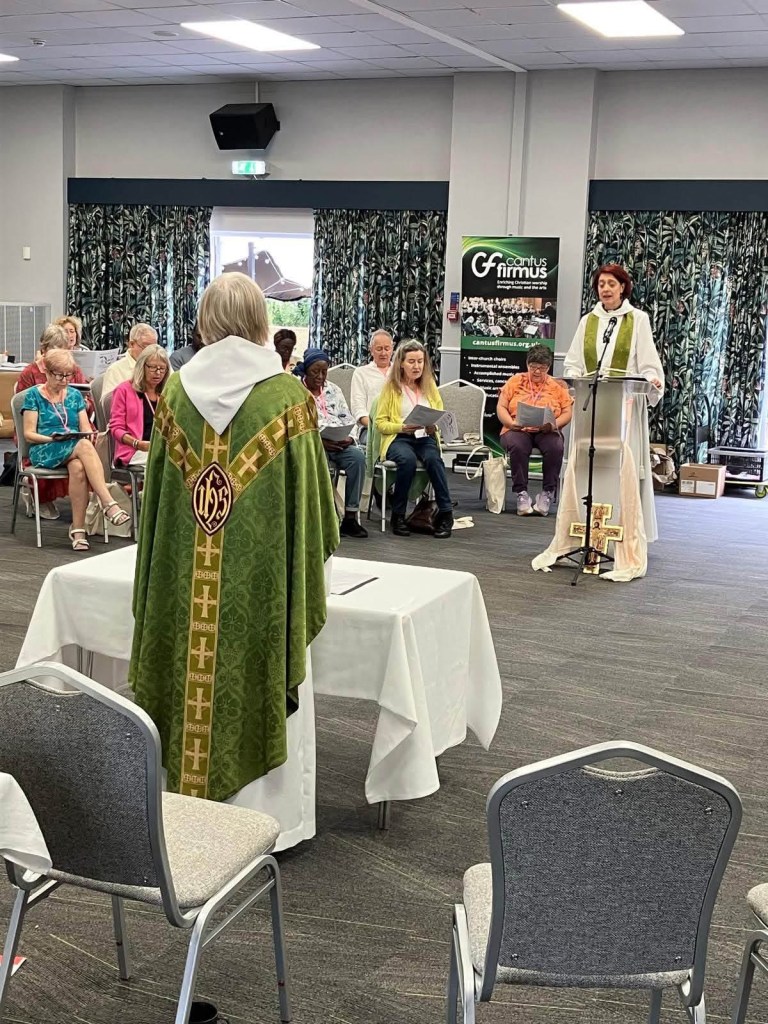
That, too, is an image of the Kingdom: not the silencing of difference, but our many voices gathered into the love of God.
Jesus ends by speaking of the scribe who brings out of the treasure house what is new and what is old.
That is our liturgical vocation too: not preserving the old simply because it is old, nor embracing the new simply because it is new, but drawing deeply from the treasure house so that every generation may encounter the living Christ.
And we can continue this work with hope because, as Saint Paul reminds us, it does not finally depend upon us.
When our words fail, the Spirit intercedes with sighs too deep for words.
When our voices falter, God’s song continues within us. We need to remember this, for this can also feel like a heavy vocation if tried to be done in our own strength – God’s got this!
And then Saint Paul gives us perhaps the most important truth about our journey towards the Kingdom:
“For I am convinced,” he writes, “that neither death, nor life, nor angels, nor rulers, nor things present, nor things to come … nor anything else in all creation will be able to separate us from the love of God in Christ Jesus our Lord.”
This is our true home.
Not a home from which we can be exiled.
Not a home reserved for the successful, the certain or the respectable.
Not a nostalgic return to an imagined past.
Our home is the love of God in Christ Jesus, and nothing, absolutely nothing, can separate us from it.
Perhaps this is the deepest hiraeth of the human heart: not simply to return to somewhere we have been, but to be drawn towards the home for which we were created, a Kingdom in which every voice is heard, every person belongs, all creation flourishes, and all things are gathered into the inseparable love of God.
This is our hiraeth, this is our hope, and this is the Kingdom drawing us home.
Amen.
 Ruth Greenaway-Robbins
Leave a comment